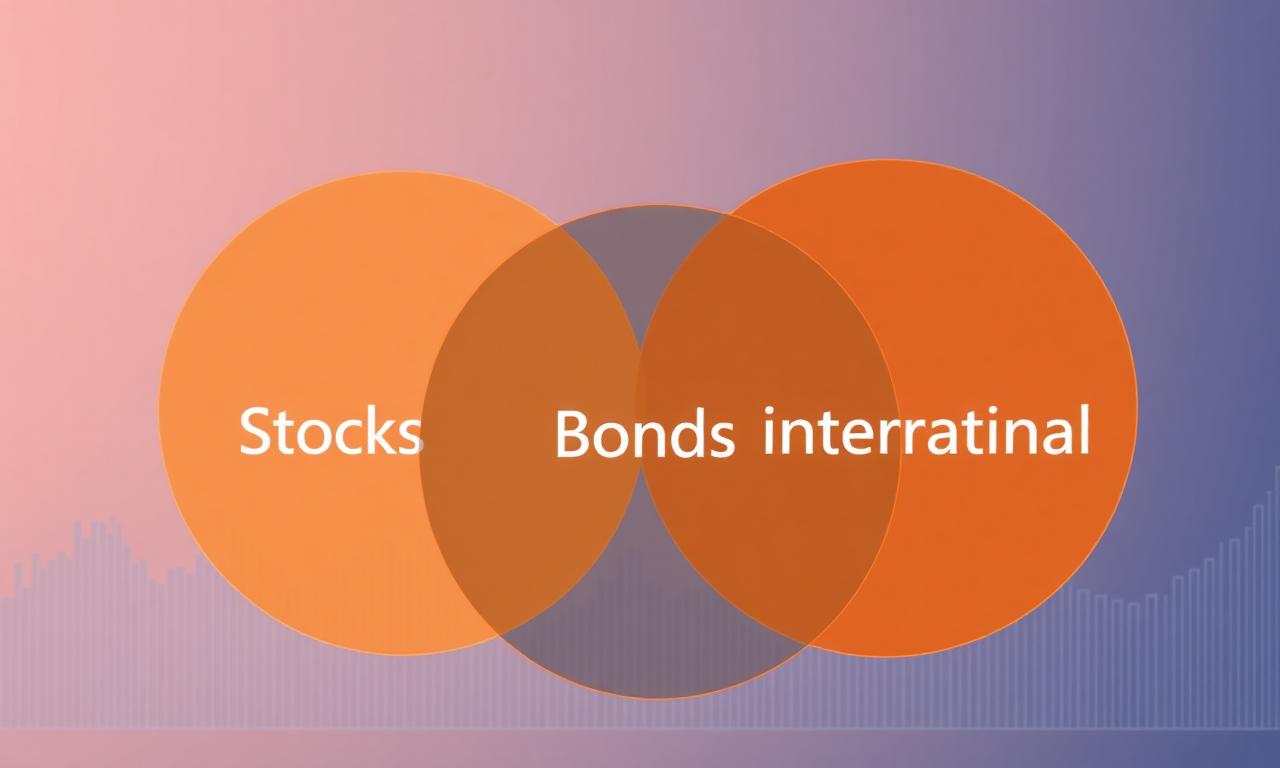
The three-fund portfolio is the closest thing personal finance has to a unanimous expert recommendation. It is exactly what it sounds like: a complete investment portfolio built from three low-cost index funds — one for US stocks, one for international stocks, and one for bonds. For most investors, in most accounts, it is genuinely all you need.
This guide explains why such a simple structure works, how to build it in any major brokerage, and the small details (allocation percentages, account location, rebalancing) that turn a good idea into a working long-term portfolio.
The three funds and what each one does
The US stock fund holds the entire US stock market — typically thousands of large, mid, and small companies — through a single low-cost index fund. The international stock fund does the same for developed and emerging markets outside the US. The bond fund holds a broad index of US bonds (and sometimes international bonds), providing stability and reducing the portfolio's overall volatility.
That is it. No individual stock picks, no sector bets, no actively managed funds chasing the latest theme. The three funds together provide ownership of essentially every major public company in the world plus a meaningful slice of the global bond market.
Why three funds beat thirty in practice
Two principles do almost all the heavy lifting. First, broad diversification — owning thousands of companies through index funds — captures the long-term return of the global economy without exposing you to the catastrophic outcome of any single company or sector going to zero.
Second, low costs. The expense ratios on broad-market index funds at major brokerages are typically 0.03–0.10% per year — a small fraction of what actively managed funds charge. Over decades, that fee difference compounds into a substantial difference in final wealth, often equal to several years of additional retirement spending.
Adding more funds rarely improves the picture and often makes it worse. Each additional fund adds complexity, potential overlap, and behavioral temptation to tinker. The three-fund portfolio is the minimum number of funds that captures full diversification and the maximum number that most investors can manage without making emotional mistakes.
~$200,000
Approximate difference in ending portfolio over 40 years between a 0.05% expense ratio and a 0.75% expense ratio, on identical $500/month contributions
How to choose your allocation
Allocation is the percentage of the portfolio in each fund. The biggest decision is the stock-versus-bond split, which depends primarily on your time horizon and your willingness to ride out market drops without selling.
A common starting framework for long-term retirement investors is an age-based bond percentage — for example, 'your age in bonds, minus ten or twenty.' A 35-year-old might hold 15–25% bonds; a 60-year-old might hold 40–50% bonds. These are not rules, just starting points.
Within the stock allocation, splitting between US and international stocks is typically 60–70% US and 30–40% international, reflecting the US market's share of global market capitalization. Some investors choose 100% US; others choose closer to global-market-weight. Both are defensible.
Three reasonable allocations by time horizon:
- Long horizon (20+ years): 60% US stocks / 30% international / 10% bonds
- Medium horizon (10–20 years): 50% US stocks / 25% international / 25% bonds
- Short horizon (under 10 years to use the money): 35% US / 15% international / 50% bonds
Where to build the three-fund portfolio
Any major discount brokerage offers low-cost index funds suitable for a three-fund portfolio — both as mutual funds and as ETFs. Within an employer 401(k), your choices are limited to the plan's menu, but most plans include broad US, international, and bond index funds with reasonable expense ratios.
If you are choosing between mutual funds and ETFs at the same brokerage, both work. ETFs offer slightly more flexibility and sometimes lower expense ratios; mutual funds are sometimes easier to automate. Pick whichever you will actually stick with.
Rebalancing without overthinking it
Over time, the funds in your portfolio grow at different rates, which causes your allocation to drift away from your target. Rebalancing means selling some of what has grown and buying some of what has lagged to return to your target allocation.
The simple approach is to rebalance once a year on the same date — say, the first weekend of every January — or whenever any fund drifts more than 5 percentage points from its target. Inside a tax-advantaged account, you can sell and buy freely; inside a taxable account, prefer to rebalance by directing new contributions to the underweight fund rather than selling, which avoids triggering capital gains.
💡 Pro Tip
Rebalance with new contributions whenever possible. Selling to rebalance in a taxable account creates a taxable event. Buying more of the underweight fund with new money accomplishes the same thing without the tax cost.
The four mistakes that trip up three-fund investors
First, adding extra funds. Sector funds, country funds, theme funds — they are rarely worth the complexity. The three funds already include everything they would add.
Second, abandoning the allocation during a market drop. The whole point of the bond percentage is to make the worst years tolerable. If you cannot hold your stock allocation through a 30% drop, your stock percentage is too high — fix it during a calm period, not a panicked one.
Third, chasing last year's winners. Whichever fund had the best return last year is rarely the best fund to overweight this year. Stick to your target allocation.
Fourth, micromanaging. Once the portfolio is built and on auto-contribute, leave it alone. Check it twice a year. Rebalance once a year. The single biggest predictor of long-term success with a three-fund portfolio is the discipline to do almost nothing for a long time.
Three funds, one allocation, contributions on autopilot, and a single rebalance per year. The three-fund portfolio works because it captures essentially all of the long-term return available from global markets, charges almost nothing in fees, and removes most of the behavioral temptations that quietly destroy returns in more complicated setups. It is one of the highest-leverage decisions an investor can make — and one of the most boring, which is exactly why it works.

Written by
Marcus LeeVerified Writer
Index Investing Writer
Marcus has been investing in low-cost index funds since 2008 and teaches new investors how compounding actually works. He covers brokerage choice, asset allocation, and Roth IRA strategy for WealthPulse.
Related Articles
 Investing 11 min read
Index Funds vs. ETFs: Which One Belongs in Your Roth IRA?
They track the same indexes, charge nearly identical fees, and own the same companies — yet one of them is almost always the better fit inside a Roth IRA, while the other quietly wins inside a taxable brokerage account. Here is the four-question framework I use with every new investor I coach.
Marcus LeeJune 2026Intermediate Investing 8 min read
How to Open Your First Roth IRA in Under 20 Minutes
A Roth IRA is the single most powerful retirement account most twenty- and thirty-somethings will ever touch — and opening one really does take less than twenty minutes from your phone. Here is the brokerage I recommend, the exact fund I tell beginners to buy, and the contribution rhythm that turns a modest paycheck into a seven-figure nest egg.
Marcus LeeApril 2026Beginner Investing 7 min read
Compound Interest in Plain English: Why $100 a Month at 25 = $349K
Compound interest is the closest thing to magic in personal finance, and yet most people get the math wrong in ways that quietly cost them six figures. This guide visualizes exactly how the curve bends, why your twenties matter so much more than your forties, and what you can still do if you are getting a late start.
Marcus LeeMarch 2026BeginnerComments are coming soon. In the meantime, share your story on our newsletter — we feature one every Tuesday.